The Premier League: Keeping It In The Family
04 September 2026

Somewhere in a hotel bar this autumn, a Brentford executive will buy an Arsenal executive a drink. They have known each other for twenty years. They will talk about family, about managers, about nothing in particular, and at some point one of them will mention, lightly, that Igor Thiago is enjoying his football. Nothing improper will be said. Nothing needs to be. By the time a bid arrives next June, both men will have known for a year that it was coming. This is how the Premier League works now, and this summer it did a record £3.46 billion of business, more than a third of it with itself.
Around 38% of this window's deals were between Premier League clubs, up from 30% a year earlier, and last season that buying and selling was worth a record £1.29 billion. Chelsea sold Enzo Fernández to a direct title rival. Newcastle armed Tottenham and Arsenal with Sandro Tonali and Bruno Guimarães. A decade ago you did not sell your best player to a competitor; when Arsenal sold Robin van Persie to Manchester United in 2012, it caused uproar. Now it is routine.
The Premier League has organised itself into something like a single trading operation: a top floor (the big six) with near-guaranteed revenue, a middle floor that develops assets for it, and rules that reward the two floors for dealing with each other. Call it a trading floor, because that is how it behaves. Nobody designed it, but as a family within the wider football family, and with clubs now owned or backed by financial behemoths, there are plenty of reasons why this has happened and, when understood, it makes sense in a market that is more of a bet than a business. This piece explains how the floor works and what to watch for this season.
Buy For £4 Million, Sell For £115 Million
Two kinds of money make it work. The Premier League distributes its television income more equally than any comparable league, so a mid-table English club earns more than the champions of Portugal, Holland and most of Italy. That income lets Brighton or Bournemouth pay £30 million for a 20-year-old and offer him Premier League minutes, which for the big six seem to be more valuable than playing for a European club. Then the big six's wealth provides the exit. Brighton bought Moisés Caicedo for £4 million and sold him to Chelsea for £115 million. Villa bought Morgan Rogers for £8 million and sold him to Chelsea for £117 million. Forest bought Elliot Anderson for £35 million and sold him to Manchester City for £116 million two years later. Three players, £348 million, one direction of travel.
The middle of the table has become the league's own scouting and development layer, and the record fees add to its income. The clubs don't deny it; some of them were built on it. Brighton's Tony Bloom and Brentford's Matthew Benham made their fortunes in professional gambling and constructed clubs that price players the way traders price anything: buy below value, add value, sell to the buyer who must pay up. Chelsea alone have spent more than £200 million with Brighton in three years.
Selling To Compete
The middle tier runs itself this way because it has to. A football club has four ways to earn: matchday, commercial, broadcast, and player trading. For a mid-table club, the first three are capped.
Matchday is capped by stadium capacity. Bournemouth's Vitality Stadium holds about 11,300 people, the smallest in the league; Manchester United and Arsenal each earn around £130 million a season from matchday alone, more than Bournemouth's entire non-broadcast income. Tottenham built a £1 billion stadium that earns from football and then NFL, boxing, and Beyoncé the rest of the year. Commercial is capped by how big the club's brand is: a global shirt deal follows a century of history and a worldwide fanbase, and no amount of good recruitment can manufacture either. On top of both sits the money that the middle hasn't reached yet: a Champions League campaign is worth £100 million plus to the big six clubs who treat it almost as a recurring revenue line, although only five can qualify.
Broadcast is the great equaliser, and the league's near-equal distribution keeps the middle solvent. But that income is equal for everyone, so it buys survival, not advantage. Which leaves player trading as the only area where a small club can genuinely outperform a giant. Brighton cannot earn more than Arsenal on tickets, shirts or television, but they can do what they did with Caicedo, and in 2022/23 that model produced the largest pre-tax profit in Premier League history, about £123 million. It is the only line on the income statement that has no ceiling.
Does this strategy make them more competitive over time? The evidence so far says yes, up to a point. Brighton have climbed from the fourth tier to sixth place and European football while selling their spine every summer. Villa traded their way into the Champions League but have had a near fire sale this summer to stay within their spending limits. Forest went from promotion to Europe inside three seasons, funded substantially by a billionaire owner and now, the Anderson sale and it's like. Bournemouth have posted their best-ever finishes on the smallest gate in the league. The model changes a club's strategy from surviving to competing.
What it has never done is sustain a title challenge, because the act that funds the squad, selling its best players, is also the act that caps it. Leicester City are the proof and the warning: the model carried them all the way to the title in 2016, then they were pillaged season after season, and they now sit in League One with the owners looking to sell. The fairytale of a decade ago has turned into a nightmare. And the closer a club gets to challenging, as Newcastle and Aston Villa have, the more awkwardly it sits in both camps: Villa paying £47.5 million for Chelsea's striker, Newcastle selling Tonali and Guimarães to rivals while finding that their £65 million striker Nick Woltemade could only be moved on to Juventus on loan.
Everyone Knows What Everyone Needs
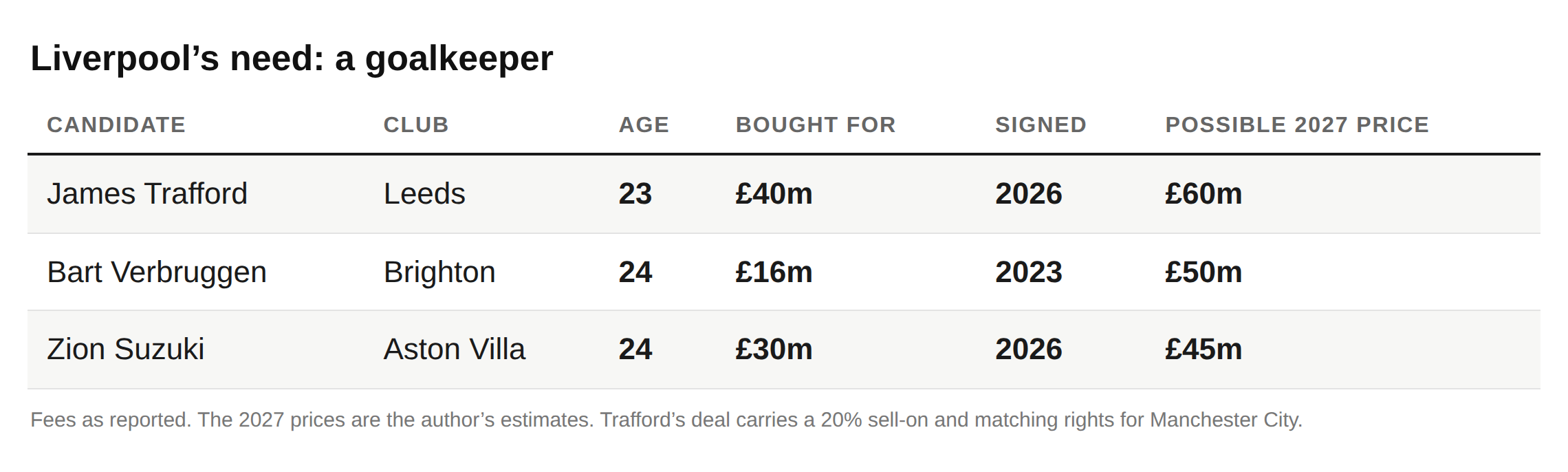
No arrangement is required, because the big six's needs are public information. Contract expiry dates are published, ages are known, and even when a detail is not widely available, the family will know it; a player's agent will see to that. Every sporting director knows that at Liverpool, both Alisson and Virgil van Dijk's contracts are up next summer.
Knowing that, look at what the middle of the table did in goal this summer. Leeds paid £40 million for James Trafford, 23. Villa paid £30 million for Zion Suzuki, 24. Coventry paid £22 million for Carl Rushworth, 25. Hull paid £20 million for Konstantinos Tzolakis, 23. Four young goalkeepers bought across the league in the last window before the biggest goalkeeping vacancy in England opens. Liverpool are already reported to be watching more than one of them.
The Football Family
The context that outsiders miss is that football thinks of itself as a family, and the family is real. The clubs are competitors for ninety minutes, but the people who run them move between clubs throughout their careers, meet regularly, and share a drink when appropriate. Nobody in the family wants to watch a rival go to the wall, and the game's structures reflect that: it is why the league shares its television money the way it does, and it is why the FA Cup matters so much here. Manchester City away at Macclesfield does nothing for City, but the match fee alone could cover Macclesfield's annual costs for that season, and everyone in football understands that the small club's survival is part of why the big club has turned up. FA Cup revenue counts for little in Premier League accounts.
That is the context for the drink at the top of this piece. The two executives in that bar will work together again, on this deal or the next one, and both of them know it. A conversation about the game, a question about a player's character, a feel for what might be possible next summer: the family talks, the market listens, and the bid, when it comes, surprises nobody. It is smoke and mirrors, and if you were to write a script around it, you might have a series worthy of Succession or Game of Thrones.
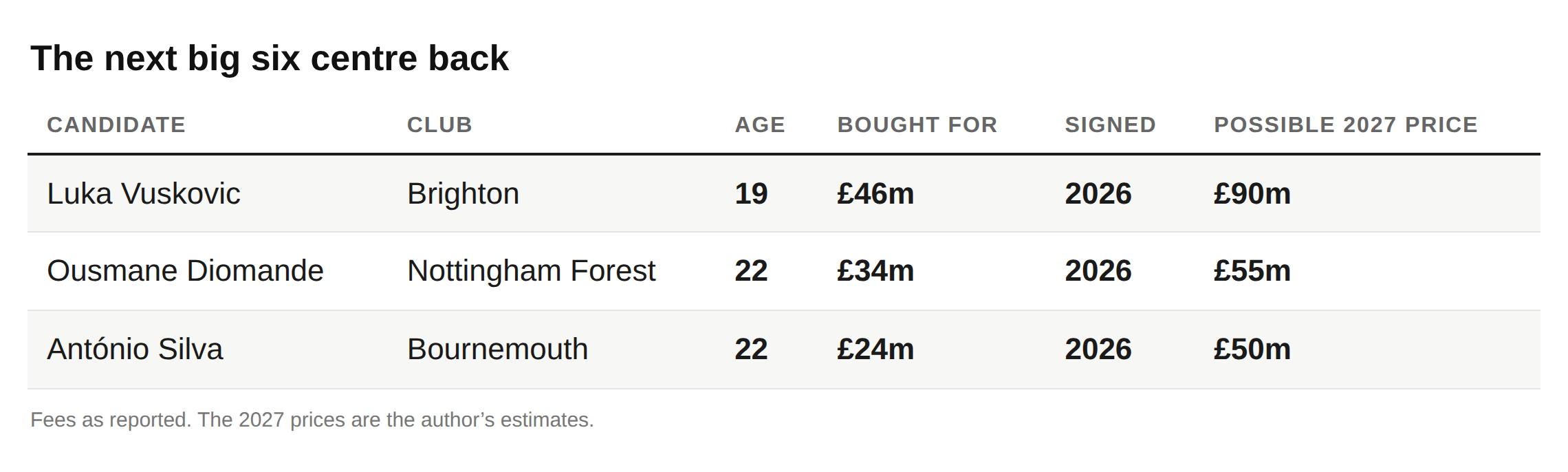
The paperwork proves the thesis. City sold Trafford to Leeds with a 20% sell-on clause and matching rights, meaning that if a rival bids for him in two years, City can match the offer and take him back. In plain terms: develop him for us, we keep an option on the outcome, and we take a fifth of the upside either way. Fulham's £34 million signing of Gonzalo García from Real Madrid carries a 30% sell-on and matching rights for Madrid. And the money flows downwards too: Tottenham sold Luka Vuskovic, a 19-year-old centre-back, to Brighton for a club record £46 million, a big six club cashing out a teenager to the league's best developer, who are betting they can sell him back up the chain for twice that.
Then add multi-club ownership. Bournemouth's owner holds stakes in clubs in France, Scotland and New Zealand. Forest's owner has Olympiacos. Chelsea's owners bought Strasbourg. Brighton's owner has a Belgian club. These clubs are feeding players into the Premier League's middle tier, with the ambition of moving them from the middle to the top.
Softening The Drop
Even relegation seems to carry less financial risk than it once did, though it would be wrong to call it solved. West Ham went down last season and still sold Mateus Fernandes for £85 million and Crysencio Summerville for £55 million, full prices, to Premier League buyers. Ipswich did something similar a year earlier, selling Liam Delap for £30 million to Chelsea within weeks of relegation. For a club that bought young, sellable players, relegation can now mean a managed sale and parachute payments rather than a fire sale.
That logic might explain why Ipswich, Hull and Coventry spent so heavily this summer. The trade press calls it the Sunderland blueprint, but it might provide an added layer of insurance, though only partially. Leicester and Southampton went down with expensive, experienced squads and found no queue formed. And for all their spending, most people would still have the three promoted clubs among the favourites to go back down. The blueprint reduces the cost of failure. It does not remove the failure.
The 2027 Market Is Already Open
So here is the forward-looking part, and it comes with a caveat: everything below is hypothetical, our reading of the market, with the 2027 prices our own estimates based on this summer's comparables. Let's go back to the bar, then, and this time imagine it is Arsenal and Liverpool getting the drinks in.
The three biggest vacancies are theirs. The current champions spent the entire window chasing Julián Álvarez at a £130 million valuation, were turned down by the player, and signed no striker; they start with Viktor Gyökeres, 28, and Kai Havertz, 27. Liverpool could be in the market for a goalkeeper and a centre-back. Every sporting director in England knows this, and the mid-tier clubs seem to have anticipated it.
The name that stands out, and the name in that hotel bar conversation, is Igor Thiago. He scored 22 league goals last season, more than anyone except Haaland, and cost Brentford £30 million. Brentford have sold Toney, Mbeumo and Wissa when the price came, and have signed a 34-year-old on a free as Thiago's understudy. By doing so, they are keeping their asset's minutes high and his succession cheap. Chelsea, meanwhile, sold Jackson and Delap into the very market they or their rivals may be shopping in later.
Conclusion
No one suggests any of this is agreed, which it couldn't be: twenty clubs coordinating a market would be a matter for the competition authorities, and pre-arranged transfers would break the game's own rules. But the market is small, transparent and so well connected that it behaves as if coordinated. The family talks; the contracts do the rest.
This operation has a single point of failure as well, and it is the same one our last piece ended on. The middle tier's model, buy the world's next tier at £30 million and sell to the top at £100 million, works only while the £100 million bids keep arriving, and those bids rest on owner funding and on revenue. It assumes both will continue to grow. That bet is the league's greatest strength and its biggest weakness, one that, should it fail, could destroy the whole business.
The 38% of deals done between the Premier League clubs is only going to rise. So now, as supporters, we can watch with half an eye on the transfer window. We know Brentford will sell Thiago for the right price, and if he gets close to 20 goals again this season, that fee will touch £100 million. Alisson and Van Dijk's Liverpool careers seem to be coming to an end, so where in the Premier League are their replacements? From a sporting perspective, it's not great, but if the Premier League is to remain the most competitive league in the world, then it makes a lot of financial sense, for as long as the top can sustain their spending. Somewhere, the drinks are already being ordered.