The NFL International Series Should Become The NFL World Bowl. This Is How.
16 September 2026

The NFL sells fewer games than any major league on earth and makes more money than all of them. The 2026 season, which started on 10 September, lasts 23 weeks, the shortest calendar in top-tier sport: 17 games, eight or nine at home, then the play-offs and a Super Bowl in Los Angeles on 14 February. While everyone else adds inventory to hold their rights fees up, the Champions League to 36 teams, Formula One to 24 races, FIFA to a 32-club Club World Cup, the NFL has sold the same 272 games every year since 2021 and earns more for them every year. That scarcity brings in $23 billion a year and is forecast to reach $25 billion by 2027. It is why the Seattle Seahawks sold for $9.612 billion in August 2026, and why a franchise worth $900 million in 2006 is worth $9.34 billion today. Scarcity, though, has a ceiling. Once the same 272 games are sold for as much as the networks will pay, the only growth left comes from something new. That is what this piece is about.
The man in charge is Roger Goodell. Revenue was around $6 billion a year when he started in 2006. He set a target of $25 billion by 2027 and is on course to hit it early. No surprise, then, that in September 2026 the owners extended his contract to 2031 on a deal that is 95% performance-based and pays him around $64 million a year, more than Patrick Mahomes and more than any league commissioner in world sport.
He was also the first to build a strategy around regular season games abroad. Others had staged the odd one; the NFL built a series, a calendar and a global sales team. The Premier League tried a 39th game in 2008, and the idea died within a fortnight; its overseas ambitions have stayed in pre-season ever since, in the Asia Trophy and later the Summer Series.
A fortnight after the Seahawks sale was approved, 100,021 people turned up at the Melbourne Cricket Ground at 10.35 on a Thursday morning to watch two teams from California. It was enough for Stephen A. Smith to tell First Take that the NFL is “rapidly becoming the number one sport in the world”. Measured by people who play it, that is a stretch. Measured by money, it is simply a fact.
NFL International Games Sell Out Everywhere They Go
The MCG is 8,000 miles from Los Angeles and hosts cricket in the summer and AFL in the winter. Most in the crowd had never seen an NFL game in the flesh. Despite that, the attendance was the seventh biggest for a regular season game in NFL history, at 10.35 am on a working day.
In 1986, the NFL created the American Bowl, pre-season exhibitions in London and Tokyo. Melbourne was the first of nine games abroad in 2026: Rio and the Maracanã on 27 September, three in London, then Paris, Madrid, Munich and Mexico City: seven countries, four continents, and three new cities. Goodell has said he wants 16 games a year outside the United States and that a Super Bowl abroad would not surprise him. The fan reaction to that might be, and there is no need to find out, when an alternative exists.
Every one of those nine games will sell out, and that says everything about the NFL as a product and a brand. But the product has outgrown its container. This piece proposes an alternative: keep the NFL season in America for the fans who own it, then branch out after the Super Bowl into an international competition for all 32 teams, played over eight weeks between the Super Bowl and the Draft. Call it the NFL World Bowl.
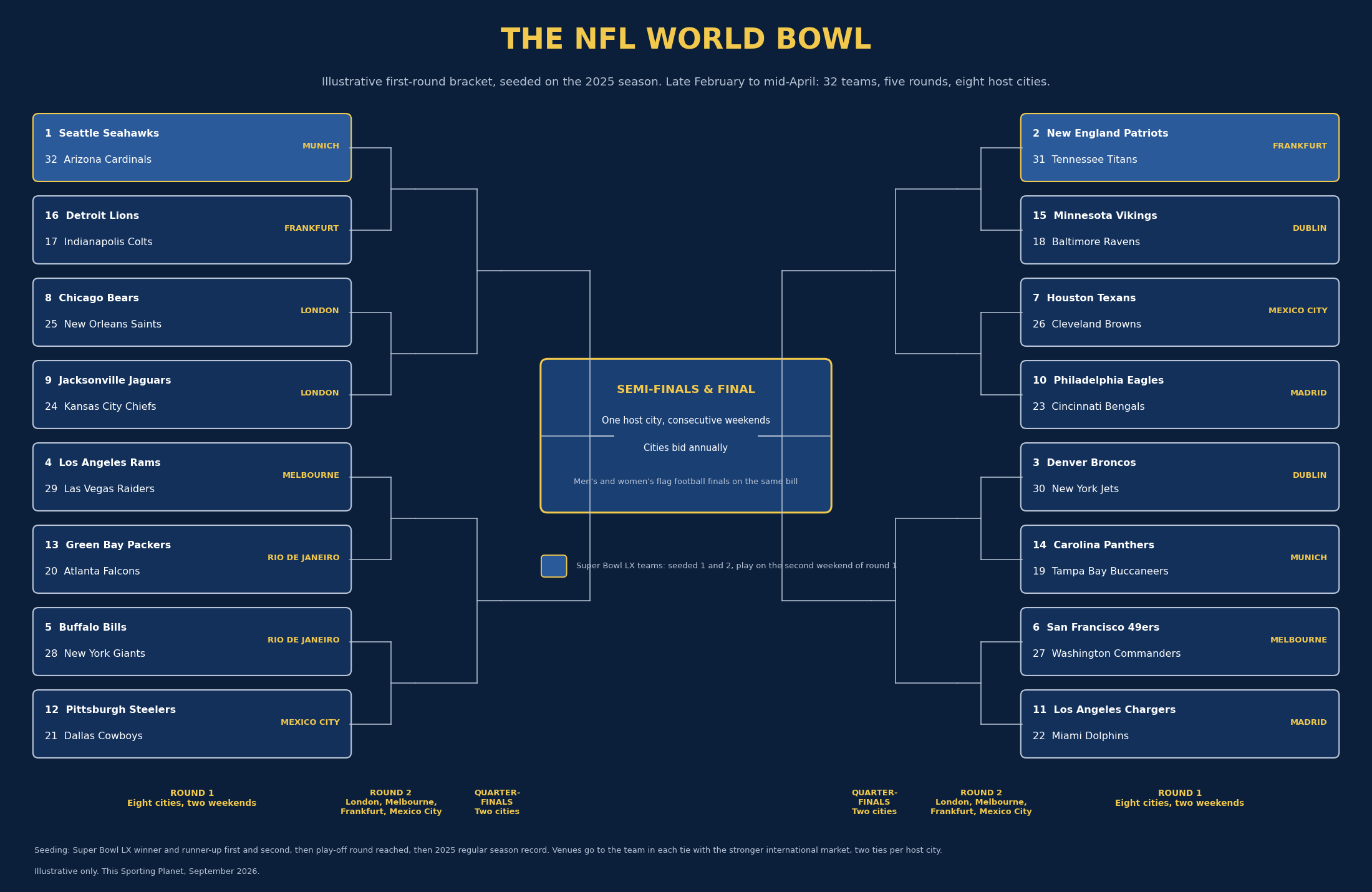
An NFL ticket is about as scarce as the product itself, so the NFL World Bowl gives the international fan a team to watch and a competition to follow at home, the way a World Cup does. The current set-up gives them one game a year in their city if they are lucky, chosen to suit the US schedule and timed for the American networks. The fans who get to a game relish it, so give them more: not just a team but a competition with a trophy.
And remember that the NFL is not one brand. It is 33: the league, the 32 teams and, above all, the players. Patrick Mahomes, Josh Allen, Lamar Jackson, Micah Parsons and Jalen Hurts are global stars. These players understand the value of their name, image and likeness, are at ease with a camera or a microphone in the helmet, and, as Netflix’s Quarterback series proved, will give up their time to get their stories told. Put them on a global stage the world can follow, and everyone benefits.
The regular season is already pushing the limits with 17 games, international travel, and games on more days of the week, and turnaround time and player welfare pay for it. Games are scheduled from Thursday to Monday, and now long-haul flights are being dropped in. A separate international window, with proper rest either side, protects them in a way that squeezing more games into the season never will. When the rights curve flattens, as every curve does, new inventory is the one lever left. The players’ agreement currently caps international games at ten a season until 2031. Goodell doubts that an 18th game will happen, but international demand remains. The NFL World Bowl would leave the 272 games that make the NFL what it is alone, creating a different product in a separate window, sold as new inventory.
The Club World Cup Shows How An NFL World Bowl Would Work
Every soccer league runs a domestic cup competition beside its league season. In the summer of 2025, FIFA built an international version of it. The Club World Cup took 32 existing clubs, played it in the summer break, and sold the global rights to DAZN for $1 billion. That became a $1 billion prize pool, and Chelsea went home with $114.7 million. The model funds itself. FIFA’s mistake was to play the whole thing in one country and ask American crowds to turn out for all the clubs: 27 of the 64 games were below half capacity. The global brands of Real Madrid, Chelsea, Bayern Munich and Paris Saint-Germain filled the stadiums. The NFL has 32 global brands and a lineup of star players in each.
Here's how the NFL World Bowl works. Thirty-two teams, a straight knockout, five rounds, 31 games, eight weeks from the end of February to mid-April, played in the cities where the teams have spent 20 years building their brand. The bracket is seeded by regular season record; the way the play-offs are, one against 32 down to 16 against 17, with venues going to whichever team in the tie has the stronger international market: Jacksonville in London, the Rams and 49ers in Melbourne, the Chiefs in Frankfurt, the Dolphins in Madrid, the Cardinals in Mexico City. The first round is 16 games across eight host cities over two weekends. The two Super Bowl teams, seeded first and second, meet the two lowest seeds on the second weekend, which gives them three weeks’ rest. The second round is eight games in four of those cities, the quarter-finals in two, and the semi-finals and final in one city on consecutive weekends. Rosters are frozen at the Super Bowl, expiring contracts run to the final, and the league year opens the week after. Any city can bid for the final, Riyadh, Doha, Lagos or Singapore as readily as London, the way American cities bid for the Super Bowl. Every game in local prime time. A trophy with a name, the Brady Trophy or the Montana Trophy perhaps, and a separate prize fund. The domestic season stays whole. Nobody in Jacksonville loses a home game.
Host Cities Will Pay: Melbourne Proves It
This is the business case, and it is why local governments will bid. Victoria signed a multi-year agreement with the NFL and got a game in a sport with no local team. Almost half the crowd at the MCG came from interstate or overseas, with tickets sold into more than 35 countries. 25,000 Americans were in the online queue on the morning they went on sale. Hotel demand for game week was 39 per cent above forecast, putting September on course for a record month. Premium tickets went for up to A$2,800. Victoria’s major-events calendar is worth A$3.64 billion a year, and the NFL has just added to it. No wonder a second game has already been agreed for 2027.
If one game does that, hosting an NFL World Bowl weekend, comprising two NFL games and men’s and women’s international flag football on the same ticket, is the kind of event a state or city treasury funds. Melbourne, Frankfurt, Madrid, Mexico City and London already have the agreements, the stadiums and the fans. Riyadh has stadiums coming for 2034 and could use a global event to fill them. Some grounds are mid-season in March: the MCG in the AFL, the Allianz Arena in the Bundesliga, but Tottenham fits the NFL around international breaks every year, and a city that wants the game finds a weekend or a second stadium. A final that moves every year is a Super Bowl auction run outside America. The International Series proved cities will pay to host. The NFL World Bowl gives them a festival worth paying more for.
Player workload is a smaller problem than it looks. Eighteen teams finish their season on the second Sunday of January, and 28 have been off for five weeks or more by the time the NFL World Bowl starts; only the Super Bowl pair play within a month, and they get three weeks and the two lowest seeds. Sixteen teams play once, eight play twice, and only the two finalists play five, with a seven-day turnaround and no midweek kick-offs, which is more rest than the domestic schedule now allows.
The union will still need a deal, and it should be simple: the full 53-man roster active on game day, in-season contact limits carried over, guaranteed money for anyone injured in the competition, and every game counting toward pensions and accrued seasons. Every team enters, and every contracted player is available, as for any other game, paid per game on top of the prize fund. The stars will want to play, because the money and the chance to grow a global brand are an excellent opportunity, and the crowd in Frankfurt paying to see Mahomes should get Mahomes.
The Draft is the one thing the NFL World Bowl must not touch: late April, three days, tens of millions watching. So the NFL World Bowl finishes before it. Start two weeks after the Super Bowl, eight weeks to the NFL World Bowl Final, done by the middle of April. Then the Draft. The knock-on is that free agency, which now opens in March, is compressed into the fortnight between the final and the Draft: a scramble for general managers, but a three-week spring schedule of live final, free agency and Draft that American television would pay handsomely for. Add in a possible $1 billion prize fund to entice the union to the table for this instead of an 18th game: new competition, new money, negotiated separately.
New sports are hard, and there is a graveyard full of them. NFL Europe invented teams and folded in 2007. In 30 years of selling American football abroad, the only thing that has reliably drawn a crowd is an established NFL team. The NFL World Bowl is built on that and nothing unproven: no new teams, no new sport, just the 32 brands the world already knows.
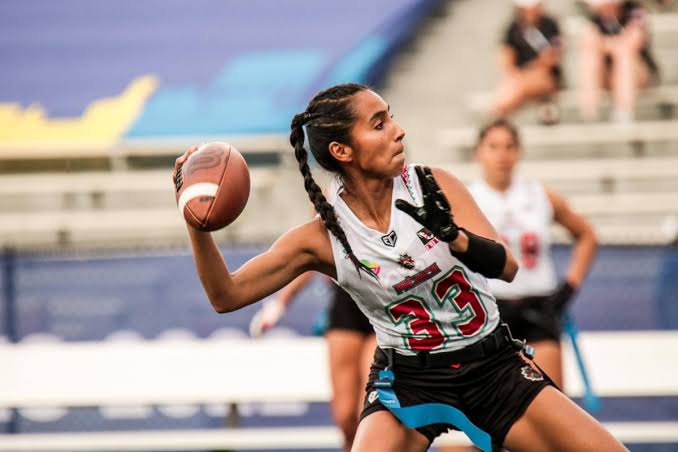
The NFL World Bowl does something the International Series cannot: it puts the NFL's pulling power behind flag football, a format the league is investing in heavily and an Olympic sport from 2028. A Munich crowd will pay to watch the Eagles, but give them a German flag team on the same bill, and they have local players to cheer for as well.
Flag and the NFL on the same weekend is a logistical challenge, but flag football has roughly 20 million players in more than 100 countries, women and men in equal numbers, and more than 200 NFL players from 25 countries want to play for their country in Los Angeles. The league plans professional men’s and women’s flag leagues before the Games and is lobbying Brisbane to keep the sport in for 2032.
So each World Bowl weekend runs on one ticket, the way The Hundred sells cricket: doors at 17.00, the women’s and men’s national-team flag games done by 19.00, since each runs under an hour, the NFL game at 19.30 and everyone out by 22.00. Rugby built its Olympic sport this way, with Hong Kong turning Sevens into a festival before the Olympics followed. Flag is the Sevens of American football, a version of the game a city can actually play.
The flag competition needs its own bracket, or it is an exhibition: 16 nations a side, seeded by IFAF’s world rankings, with one round played at each NFL World Bowl weekend. The first-round ties write themselves. Mexico’s women, ranked first in the world, at home in Mexico City. Australia against Japan in Melbourne. Great Britain’s women, European champions, against Italy in London. And Germany against Austria in Munich, a local derby to open the day. Make those rounds count towards Olympic qualifying as well, since IFAF, which runs the qualifiers, has no stadiums or crowds of its own, and finals weekend becomes the NFL World Bowl and the men’s and women’s flag finals on the same bill, with a half-time show and all the razzmatazz of the Super Bowl. A longer day in the stadium, with Beyoncé or Ed Sheeran at half-time, and nobody will mind.
US Fans And Broadcasters Lose Nothing
Neither US fans nor broadcasters lose out. More than 18 million Americans watched the São Paulo game on YouTube in 2025, so the American networks know they would have an audience and would pay for it, alongside local broadcasters in every host country.
The time zones work too. An evening game anywhere in the Americas lands in US prime time. An evening game in Europe or the Middle East is American lunchtime, and an evening game in Australia is early on a Saturday morning in New York, the slot NBC used to build the Premier League’s American audience from scratch. Between late February and April, those windows are open: the MLB has barely started, the NBA and Stanley Cup play-offs are evening properties, and spring Saturdays are college basketball and golf. The NFL World Bowl clashes with some of that, but most of it lands in hours the networks currently fill with repeats.
A daytime window requires a shorter game. Make World Bowl games two and a half hours, not three and a quarter. Cut the team timeouts to one a half, tighten replay, keep the media breaks because they pay for it, and keep the two-minute warning because it is the best piece of theatre the sport has.
The NFL World Bowl Grows The Game Beyond America
When the NFL confirmed the February 2027 Super Bowl for Los Angeles, Goodell called the city the league’s backyard and, in the same statement, mentioned flag football at the 2028 Olympics. He sees an opening for the game’s expansion. Launch the NFL World Bowl in the spring of 2028, and it lands three months before those Games open. Play the 2032 final in Brisbane and the city has hosted the sport before its own Olympics begin. An annual competition builds towards flag football’s pinnacle, and the NFL teams the world already knows get a second trophy to play for.
That is the vision: a league that serves both its fan bases at once. The American season, the most valuable thing in sport, is never touched. The international fan base, which today gets one game a year chosen for somebody else’s television schedule, gets its own competition, with the stars in its cities instead of on a screen.
Whether the owners or the executives give it much thought is another matter. At This Sporting Planet, we know how much it matters to serve the global fan, because fandom is different in every country and every one of them can tell when it is an afterthought. That fan base has found its voice. It sold out the MCG in a morning; it bought tickets from more than 35 countries, and it will start to ask for more than a visit.
The NFL has 32 teams the world already knows and 20 years of cities that want them. It has never waited to be asked before. Give those cities a competition and a trophy, and the league sells new inventory in a window it does not currently own; the players build their names in markets where a Mahomes jersey is still a rare sight, and the sport grows beyond its borders.