Tired Of Sport: Here's Why The Game Must Choose To Become Smaller
08 October 2026
Novak Djokovic won the China Open without completing his final two matches. In fact, none of the last three men’s matches finished on match point, and, staggeringly, 20 players withdrew from the women’s event, eight of them would-be seeds.
Injury is part and parcel of sport, but this is becoming a pattern, and the calendar and the sheer volume of sport are being blamed. The players are not the only ones feeling it. Growing signs suggest the fans, the lifeblood of any professional sport, are worn out too.
The Sports Rhythm
When This Sporting Planet launched, Todd Harris, our US host, talked about the rhythm of American sport, with each league owning its own window of the year: the NFL playoffs in January and February, the NBA and Stanley Cup playoffs from April into June, baseball and golf through the summer, and the World Series in October.
Back in 1990, before Sky and the Premier League changed everything, the UK calendar had a similar rhythm. League football ran through the winter, but other competitions had their moments: the FA Cup third round and the Five Nations in January; Cheltenham and the first Formula One race in March; the Grand National in April; and the cup finals in May. Summer belonged to Test matches, Wimbledon and athletics, and in August the football began again. A generation on, all of that still exists, but more, much more has been added.
A Bubble Starting To Deflate
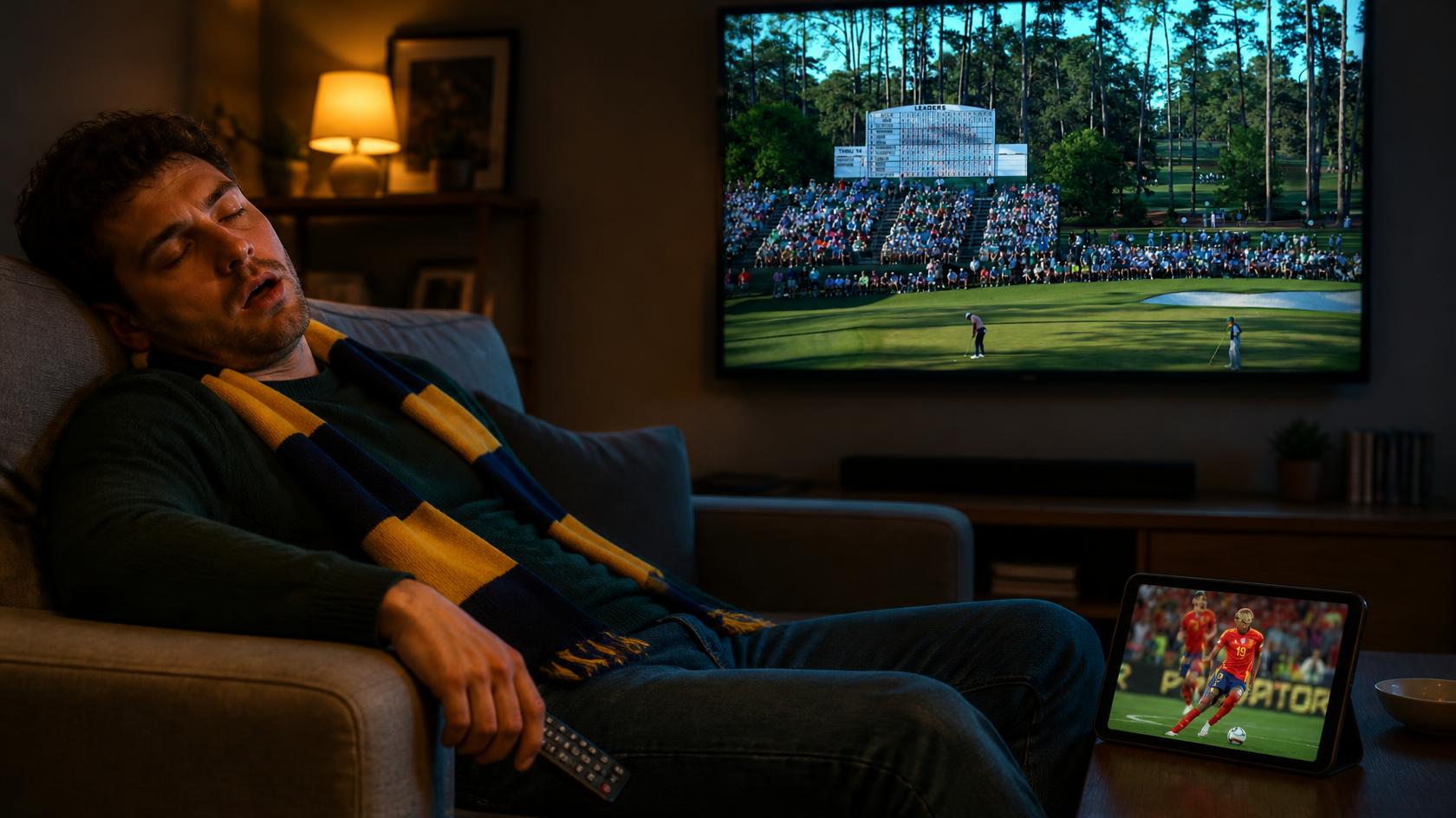
The broadcasting landscape is why it has changed. Pay TV, which began in the US in 1975 and expanded rapidly in the 1990s, was joined by streaming, YouTube, and social media, and sport was the perfect content to fill the airtime. New broadcasters paid handsomely, so sport offered more: international leagues, coverage of every event, and matches from around the world. Half a century on, that pay-TV model is shrinking and fragmenting, and the boom is starting to look like a slowly deflating bubble. Fans are fed up with following their teams across multiple apps and platforms, known as ‘subscription fatigue’, and a more concerning tiredness is creeping in alongside it: decision fatigue.
Decision fatigue stems from what the psychologist Barry Schwartz called the paradox of choice: some choice liberates us, but too much paralyses us. With so much action available as social media clips or catch-up highlights, and so much live sport on offer, viewers are becoming overwhelmed.
Eddie Pepperell, a professional golfer and host of The Chipping Forecast, mentioned it on the excellent Business of Sport podcast. When referring to his own experience as a fan, he said:
“Well, I think that’s the problem of growth, isn’t it? If you’re always trying to grow, a contradiction is inevitable, because you can only extract so much from so many sources. And maybe we’re at that point... I certainly know how I feel about consuming sport. I feel tired.”
That is decision fatigue in a nutshell, and many fans will understand it. It’s a sentiment that should worry sports executives and governing bodies alike.
Choosing Has Become Hard Work
Pepperell's commentary is significant because he was born in 1991. At 35, he sits right in the middle of the audience demographic that every sport wants to attract. He told us that he used to love watching the Premier League at the start of the century, but since Covid, he has barely watched it. If he is tired, those younger than him, with even more distractions, are increasingly unlikely to sit down to watch a two-hour match or a day’s play from St Andrews.
Our own research revealed that, on one Sunday in October, a UK fan with access to every channel could choose from 116 fixtures, before including anything on YouTube. Many start at the same time, but the range is enormous: the NFL, the NHL and MLS; European domestic football; rugby union; UFC; motor racing; golf; tennis; Test and T20 cricket; darts; horse racing and cycling. Simply deciding what to watch is a challenge. Staying up is another one.
Then there is the challenge and stress of attending matches. Football’s kick-off times are scattered across the week, so an Arsenal supporter could be in Paris for a Champions League match on Wednesday night and then face a 14-hour round trip to Sunderland for a 12.30pm kick-off on Saturday. Early starts, late finishes, and the cost of tickets, travel, and accommodation make it expensive and tiring, forcing fans to choose. Decision fatigue again.
The Players Want to Rest
The sound of player unrest around their commitments is increasing. Footballers have mentioned it, but the loudest voices have come from Tennis. In the space of two days, two stories made the point. Jannik Sinner, the world number 1, ended his season because his knee needs treatment. Then there is what happened in Beijing. Hubert Hurkacz retired injured in one semi-final, Daniil Medvedev was defaulted in the other, and Alex de Minaur, who has played more than 50 matches this season, conceded the final to Novak Djokovic at the start of the second set because of injury.
After a busy and successful 2025, Taylor Fritz told ESPN, “I get one week off the whole year.” This year, Aryna Sabalenka has called the calendar insane and said she’d accept fines for skipping events, and at the US Open, Carlos Alcaraz said it was “impossible”.
Even the clock doesn’t stop tennis. Floodlights and roofs have created night matches and protected them from the weather, and while Wimbledon has an 11pm curfew, matches in the US and Australia regularly finish in the small hours. Some have even started after midnight. This year Venus Williams began her first-round match at 12.13am in New York, the latest start in US Open history, and men’s finalist Ben Shelton played two matches that finished at 2.07am and 3.33am. In Melbourne in 2023, Andy Murray played a match that finished after 4am. By the end, none of them finished in front of a packed stadium, which raises the question: why?
In Football, Rodri, a European champion with club and country, warned in 2024, the year he won the Ballon d’Or, that players were close to striking. He said 40 to 50 matches a season was now the limit for a player at the highest level. Days later, he tore his anterior cruciate ligament against Arsenal and missed the rest of the season.
Rugby has a serious problem with head injuries, and hundreds of former players are taking legal action. More tests mean more training and more collisions. Even Pepperell missed the Irish Open with a neck injury, which he put down to being ‘over-practised, under-slept and overstressed’.
Add the travel and the uncertainty for tennis and golf players over whether they will be playing at the weekend or even next week, or for footballers having to decide whether to withdraw from international camps to stay fit for their clubs. It’s tiring, and like the fans, players are being forced to choose their health and wellbeing over points, prize money, and caps.
The Hamster Wheel Calendars
The problem is the calendar. There has always been sport year-round. What has changed is that each sport now wants the whole year to itself, with no meaningful break. The calendar has become a hamster wheel that never stops turning.
Start with Pepperell’s sport, golf. In 1990, the European Tour ran for eight months with 37 events. Today, the DP World Tour has 42 events in 25 countries and runs from November to November, with the four majors, the Ryder Cup and the Olympics fitted in around it. Formula One has grown from 16 races in 1990 to 24 this season, and MotoGP from 15 rounds to 22. MotoGP also runs a sprint race every Saturday, so fans now need to watch 44 races to follow the championship. The riders race twice every weekend, plus qualifying, whereas there used to be a single race on Sunday.
This summer’s World Cup had 48 teams and 104 matches, double the 1990 edition. Some international footballers had as little as two weeks off afterwards. The major rugby nations play nearly four times as many tests as they did in the 1980s, and a new Nations Championship Finals Weekend has just been added. When cricket’s T20 internationals began in 2005, each country was limited to three home matches a year. In 2025, 576 were played. Tennis has fewer tournaments than it did, but seven of its nine Masters events now last 12 days instead of seven.
In 1990, sport gave athletes and fans a break: weeks for bodies to recover and for fans to miss it. In 2026, every week is a chance to play. Football, rugby, golf and tennis run all year, and F1 and MotoGP pack more races into nine months than ever before. Sport, in short, has forgotten how to stop.
Sport Needs a Scarcity Principle
The best lesson for sport comes from outside it: scarcity creates value. Enzo Ferrari’s rule was to build one car fewer than the market wanted. Hermès keeps a waiting list for its bags. A numbered limited edition of a book is worth more because there are fewer copies. Sport has gone the other way. It has never been easier to watch; it is played all the time, reducing each event’s value as a result.
Pay TV has brought sport enormous wealth, and football has been the primary beneficiary. In 1992, Sky’s first Premier League deal showed 60 live matches a season. Under the new £6.7 billion deal, which runs until 2029, Sky and TNT Sports can show up to 270 of the 380 matches. The league had to sell 70 more live games than in the previous cycle to maintain its income level. Broadcasters are paying roughly the same each year for more football, so each match is worth less. That is what a deflating bubble looks like.
And the new buyers value scarcity. Netflix has said it is not in the volume business. It buys single events with large, measurable audiences such as an NFL Christmas Day doubleheader, a heavyweight fight and a Women’s World Cup. The squeeze will fall on everything below that level. The regular tour event, the early-round midweek fixture, the competition invented to fill a gap in the schedule. If those events fail to draw an audience, the broadcasters won’t buy them, prize money will drop, and athletes and sponsors will walk away.
Pepperell applied the scarcity principle to golf, and to the PGA Tour’s 2028 plans in particular. The tour will split into a Championship Series and a Challenger Series, with the Korn Ferry Tour beneath them. That structure suits the American market. Add the DP World Tour and, by Pepperell’s count, there are four tours of around 120 players each, playing for roughly $500 million. He cannot see how that is sustainable when only 50 of those 500 golfers are well known enough to matter to the wider public.
The boom has made professional athletes rich. Twenty20 has transformed cricketers’ earnings, and Emma Raducanu answered other tennis players’ complaints about the calendar by pointing out that “we are making a great living”. But wealth has given the top players choice, and they are using it. Carlos Alcaraz plans to take breaks of a month or two and skip tournaments. Maro Itoje was rested for England’s summer Tests. Aryna Sabalenka has said she will accept fines to miss events. When the stars stay away, the events lose value.
The governing bodies have started to act, but slowly. FIFA’s merger of the September and October international windows moves matches around without reducing the number of matches. If the stars keep rationing themselves, the bubble will deflate, and the calendar will start to look more like it did in 1990, with each sport owning its window of the year. Every event will still be available to watch online, but fans will know which ones matter most and where to spend their time, money and energy.
Less Sport, More Value
Regular readers of This Sporting Planet know we admire the NFL. Its success comes from scarcity. The most valuable league in the world plays once a week, for around five months of the year. We have argued for a dedicated international window, which would also ease players' travel load during the regular season. But the short season is the foundation: it keeps the story tight, the stadiums full and, crucially, the fans free to watch other sports. Each of America’s major leagues has built its identity around a season with a clear start and a clear finish.
When pay TV launched, sport needed to grow, and the two were an ideal match. Sport has used it brilliantly to grow. Now it needs to cut back, because its stars and customers are becoming selective.
The fans are tired. More and more are complaining about ticket prices and travel costs, with some arguing that the quality on show doesn’t justify the expense. The star players, made wealthy by the boom, now choose when to play and, more worryingly, the new broadcasters have become selective. Netflix buys the big occasions and leaves the week-to-week grind of leagues and tours to others. For them, a single major event is worth more than a whole season. It’s a response to the endless choice that has left viewers overwhelmed and is making each event worth less. When the audience shrinks, the money follows, and sport will be forced to cut back.
Pepperell spoke for many fans when he said he was tired of sport, and he has admitted that his own game, golf, “is going to have to choose to become smaller”. Every sport that runs all year should take note. The cure for fatigue is rest: time for players to recover, for fans to miss it, and for other sports to have their own window. Players and broadcasters are already choosing, and fans will follow. It’s time for sport to say:
Less Sport = More Value