Sunderland, Europe And The Premier League Survival Conundrum
23 October 2026
It is still early, but seeing Sunderland at the bottom of the Premier League table is a surprise. They got off to a strong start, earning four points from their first three games and a place in the fourth round of the Carabao Cup. Since then, they have lost four straight league matches. Alongside that run, they are unbeaten in the Europa League, their first European campaign since 1973, with wins over AZ Alkmaar and Torreense and a 1-1 draw away to Lech Poznań on Thursday night. The two look connected. European demands appear to be hurting their league form, on top of the dip expected after an excellent first season back in the top flight. This isn’t a new phenomenon. But Sunderland have had only one season in the Premier League, and three transfer windows to build a squad for both competitions, and this dip in form could prove disastrous.
Thursday to Sunday football has always tested English clubs, but the new extended league phase now coincides with one of the busiest stretches of the Premier League season, and the strain is harder to hide. Since 2024, the Europa League has added two more rounds, so it now runs until the end of January. In those two seasons, despite Premier League clubs winning all four Europa League and Conference League titles, four of the six English clubs that reached the quarter-finals or beyond finished 15th or lower at home. The league phase has improved their chances of winning European silverware, whilst placing their league survival under threat.
The carrot for winning the Europa League is qualification for the Champions League, which adds around £16m to the coffers just for entering, but from a purely financial perspective the reward for success in the competition is low. A perfect Europa League season is worth close to £30m, about the same as the gap in Premier League prize money between finishing seventh and 17th. In other words, a top-half league finish pays almost as much as a European trophy, without the risk. Every place lost costs around £2.7m, but if European success costs you as many as ten league places, there is no upside. Tottenham’s Europa League win cost them a drop from fifth to 17th, worth roughly £32m. Relegation, at around £100m, is the worst-case scenario.
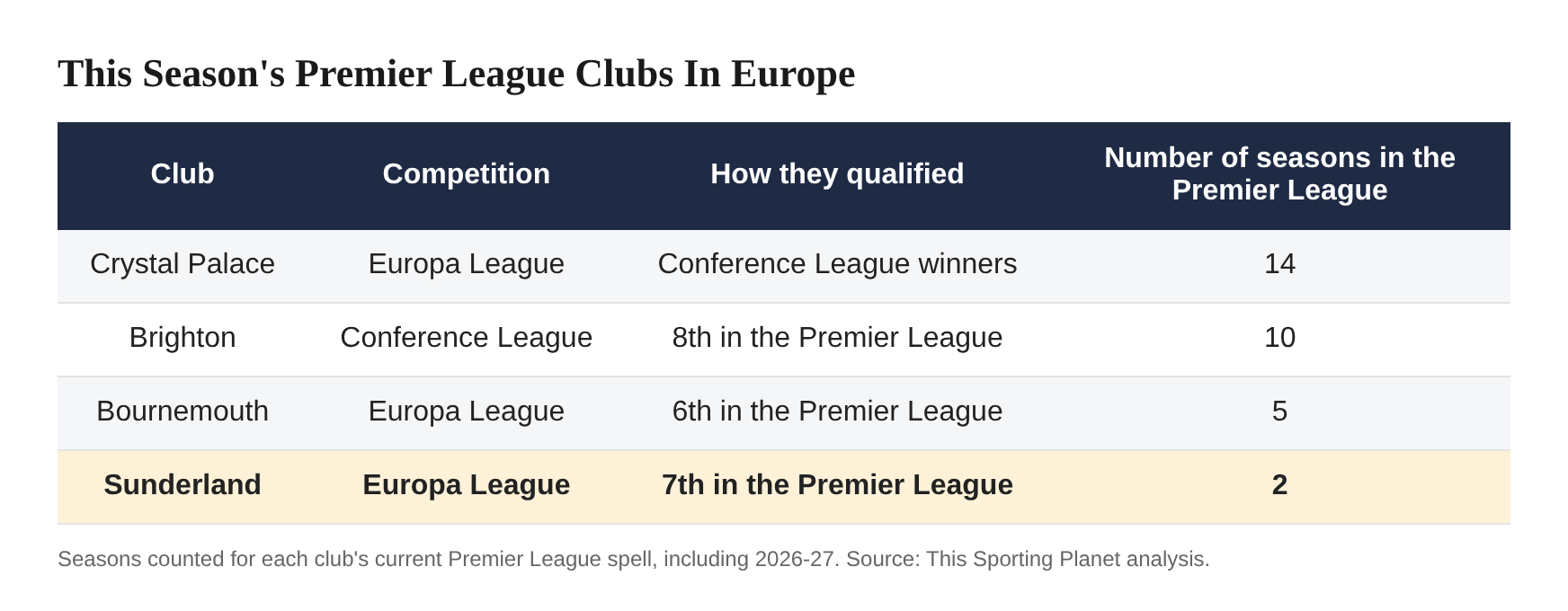
This season, Sunderland, Crystal Palace and Bournemouth are in the Europa League, and Brighton are in the Conference League. Sunderland stand out. The others have spent at least four seasons in the Premier League, building squads big enough first to survive and then to compete in Europe. Sunderland qualified in their first season back. The clearest sign of how thin their squad is lies in their European registration. UEFA allows 25 senior players on List A. Sunderland registered 22, leaving three places empty, and topped up the numbers with 19 academy players on List B.
The table below shows how each club qualified and how long it has been in the league. Brighton’s early form suggests a team entering Europe can cope, and Palace have the experience to manage. For Bournemouth and Sunderland, both currently in the bottom half, last season’s success could backfire this season. They have qualified for a competition that runs at least to the end of January, leaving them fewer games to focus on survival. European competition could mean relegation from the Premier League. Yet the Premier League is so strong that last season’s league form gives them a strong chance of success in these lesser European competitions, and fans always welcome any trophy. It is a huge conundrum: European silverware or Premier League survival.
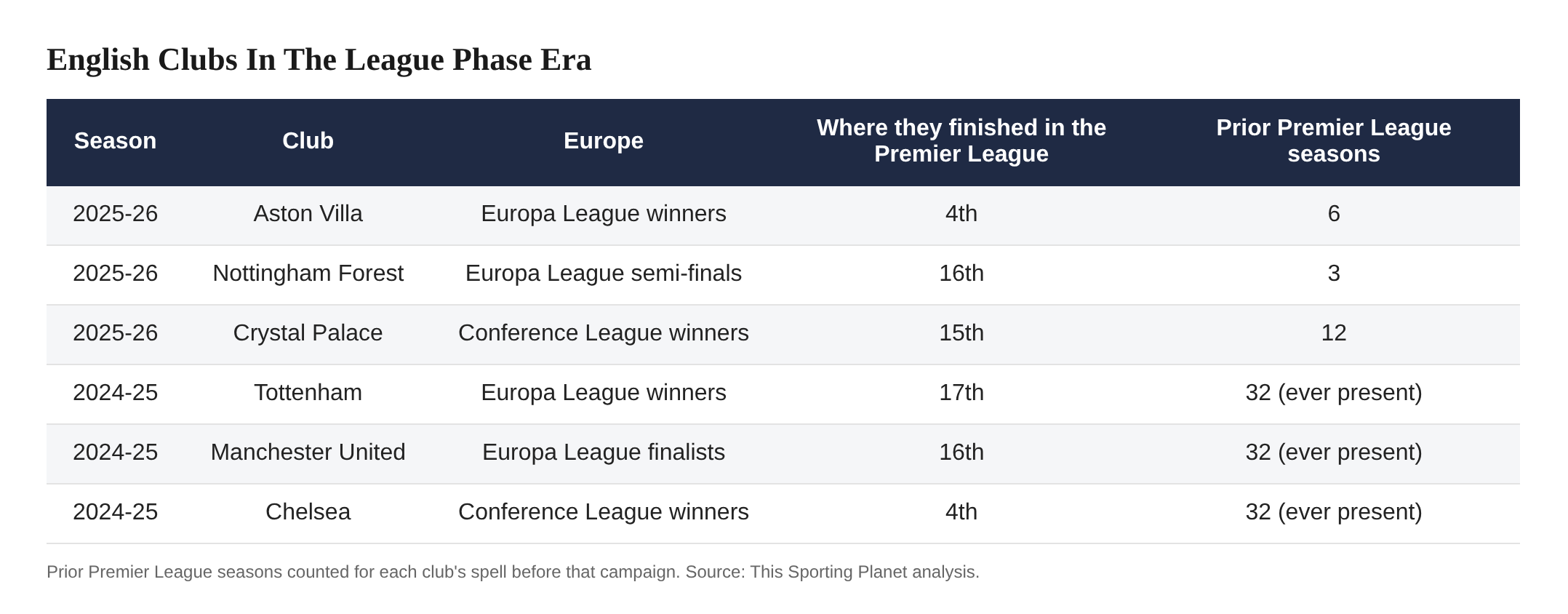
The league phase is only two seasons old, but a pattern is emerging, at least for the English teams. In the first season, 2024-25, Tottenham’s Europa League victory coincided with finishing 17th in the Premier League and becoming the first top-flight side to lose 22 of 38 games and still stay up. Ange Postecoglou, despite delivering the club’s first trophy for 17 years, was sacked two weeks later because of their league form. Manchester United, their opponents in the final in Bilbao, finished 16th. Ruben Amorim survived that summer but not the following winter. After a season without European football and under Michael Carrick, United finished in the top five.
Last season, Crystal Palace won the Conference League and finished 15th. Nottingham Forest reached the Europa League semi-finals and finished 16th. Sean Dyche was sacked in February when the club were 17th. Only Chelsea and Aston Villa, the two clubs with the deepest squads, combined a European trophy with a top-four finish. For the rest, Europe has hurt their league position, hit their finances, and, in most cases, cost the manager his job. Proof that Premier League survival and league position remain the priority for chairmen and owners.
Built To Survive, Stretched By Europe
Sunderland’s rise has been remarkable, and they deserve every plaudit that comes their way. They have done almost everything right since dropping into League One in 2019, returning through the League One play-offs in 2022, then winning promotion to the Premier League via the Championship play-offs in 2025. They finished seventh in their first season back. History suggests repeating that was always unlikely. Clubs that excel in their first season often fall back in their second. Ipswich finished fifth in 2000-01 and were relegated a year later, while also playing in the UEFA Cup. Reading went from eighth to relegation in 2007-08. A bottom-half finish this season would still have been a respectable return. It is sad and strange that this success could become their biggest punishment, and one that is totally undeserved.
Sunderland spent £161m on 15 players ahead of their first season to build the squad that kept them in the league. Le Bris insists work to deepen that squad is underway. “It is demanding, but our squad depth is getting better,” he said before the trip to Torreense. But squad depth takes several seasons to build, not the three transfer windows Sunderland have had since winning promotion. They must also stay within the league's spending limits. Those limits shaped the £60m they spent this summer, but it hasn't delivered a squad deep enough to cope with all their commitments.
Sunderland are a Premier League club, judging by their fanbase. Their income, around £213m last season, is close to what Nottingham Forest earned after three seasons back in the top flight. Both UEFA’s and the Premier League’s financial rules create a problem. The Premier League lets clubs spend up to 85% of their revenue on squad costs, mainly wages and transfer fees. Clubs in Europe, however, must meet UEFA’s 70% limit. For Sunderland, that's roughly £30m a year less to spend on the squad, enough to bring in the three senior players who would fill those empty List A places.
Then there is the additional workload. Sunderland are currently in the middle of a schedule that sees them play nine games in the 30 days between the 10th of October and the 8th of November. Before the AZ Alkmaar game, Le Bris said, “We will need more than 11 players to be competitive in both competitions”. This squad can either survive in the Premier League or play and win matches in the Europa League, but not both.
Now consider that the Europa League’s league phase doesn’t finish until the end of January. It used to end in December, before the festive fixtures. Now even the earliest European exit leaves just 16 Premier League games, a maximum of 48 points, to play free of Thursday nights. If Sunderland reach the knockout play-offs and go out there, their European campaign ends in late February, leaving just 12 games, or 36 points, to play for.
Since the Premier League became a 20-club league in 1995-96, the 17th-placed side has averaged 34.5 points. Last season the bar was higher: Tottenham survived on 41, while West Ham went down with 39. A realistic target for Sunderland is 36 to 38 points, and they have four from seven games. Sixteen Premier League matches remain through the end of January, and 15 after that. The table below shows what they need from each stretch to reach 38.
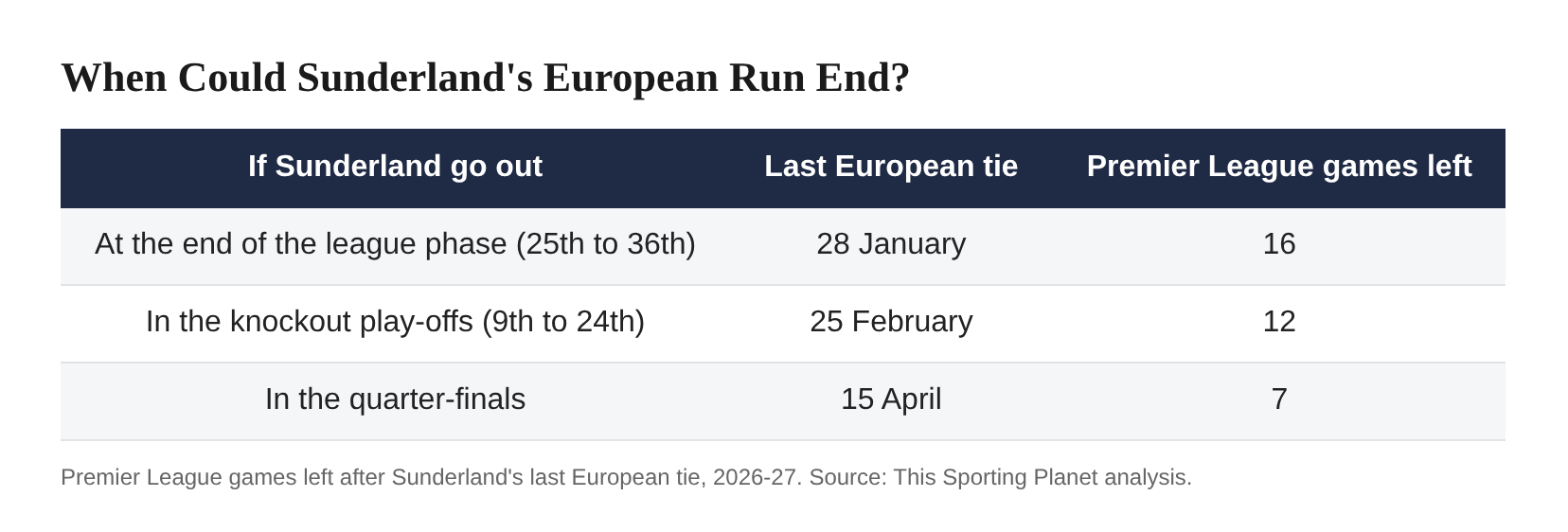
Twenty points by the end of January keeps them in the fight, but it is a 33-point season pace, which would leave a lot of heavy lifting for the spring, and Europe may still be running. Having 24 points would make them feel far safer, though it would still require roughly a point a game from February. Either way, they need another 32 to 34 points from their remaining 31 games to stay in the Premier League, while playing in Europe, the Carabao Cup and, from the new year, the FA Cup.
The FA Cup third round starts on the 9th and falls between a midweek league round on the 6th and Europa League nights on the 21st and the 28th, around eight games in four weeks. If Sunderland’s Premier League form doesn’t improve in November and December, January could be very stressful. If they beat Brentford in the Carabao Cup on the 28th of October, they'd add a quarter-final and a potential two-legged semi-final to that.
A Mountain To Climb
It seems crazy to suggest that, seven league matches and two months into the new campaign, Sunderland have a mountain to climb. They earned their European adventure on the pitch, and Wearside fans had a great night celebrating their return to Europe in September. In an ideal world, they might have wanted another season or two focused on the Premier League, building a squad deep enough for two competitions before testing it in Europe. But success breeds success, and reaching Europe so soon after promotion is a significant achievement. A dip in their second season was always likely, and a bottom-half finish would be no failure. Relegation would be, and that is why it feels like they are at the bottom of the mountain right now.
If they backed up last season’s finish by winning the Europa League, they would have gone from League One to the Champions League in five years. Outstanding. That Champions League place would be worth far more than the trophy itself. Right now, that looks fanciful. And if their league form doesn’t improve, do they forgo that opportunity to stay in the Premier League? Even winning the Europa League and qualifying for the Champions League pays less than staying in the Premier League. That is the conundrum: European silverware or Premier League survival.
Their situation could change quickly, and Sunderland fans will hope it does. An upturn in league form would transform the picture, and a mid-table finish alongside a solid European campaign would give Sunderland the income, experience and platform to build a squad capable of competing on several fronts more often. Sunderland are a Premier League club with a squad capable of doing well in Europe this year, but last season’s success is punishing them this season, a tough pill to swallow. Premier League survival, financially and in every other sense, matters more than competing on several fronts. The question now is whether they can keep playing in Europe without leaving themselves a mountain to climb to stay in the Premier League.